Blog
Notes from building LeonSim
Engineering write-ups: what we measured, what broke, and what the numbers can and cannot tell you.
Where LeonSim’s validation stands on 23 October
Four 2D cases have now been run three ways: against published data, against OpenFOAM on the same case, and in LeonSim. This is the status of each in one table, what each does not show, and what is not validated yet.
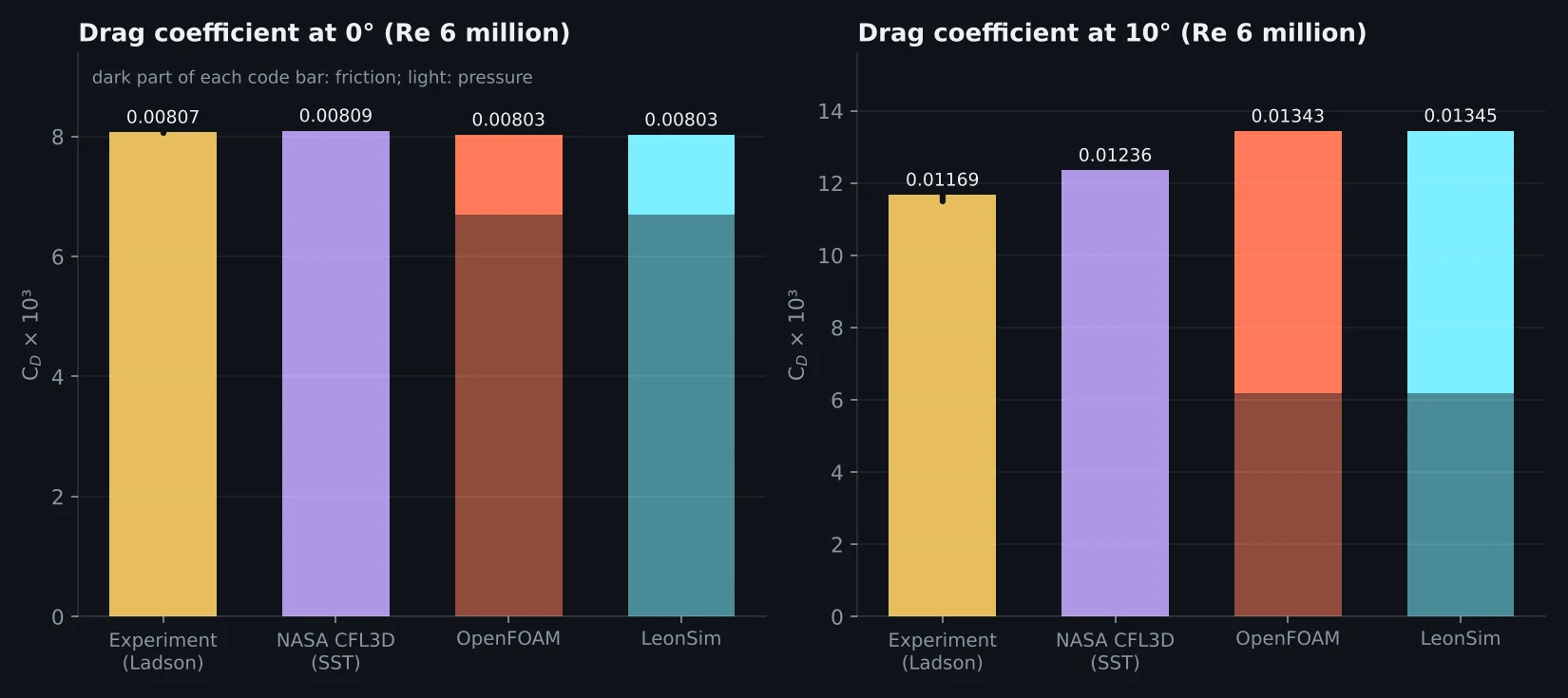
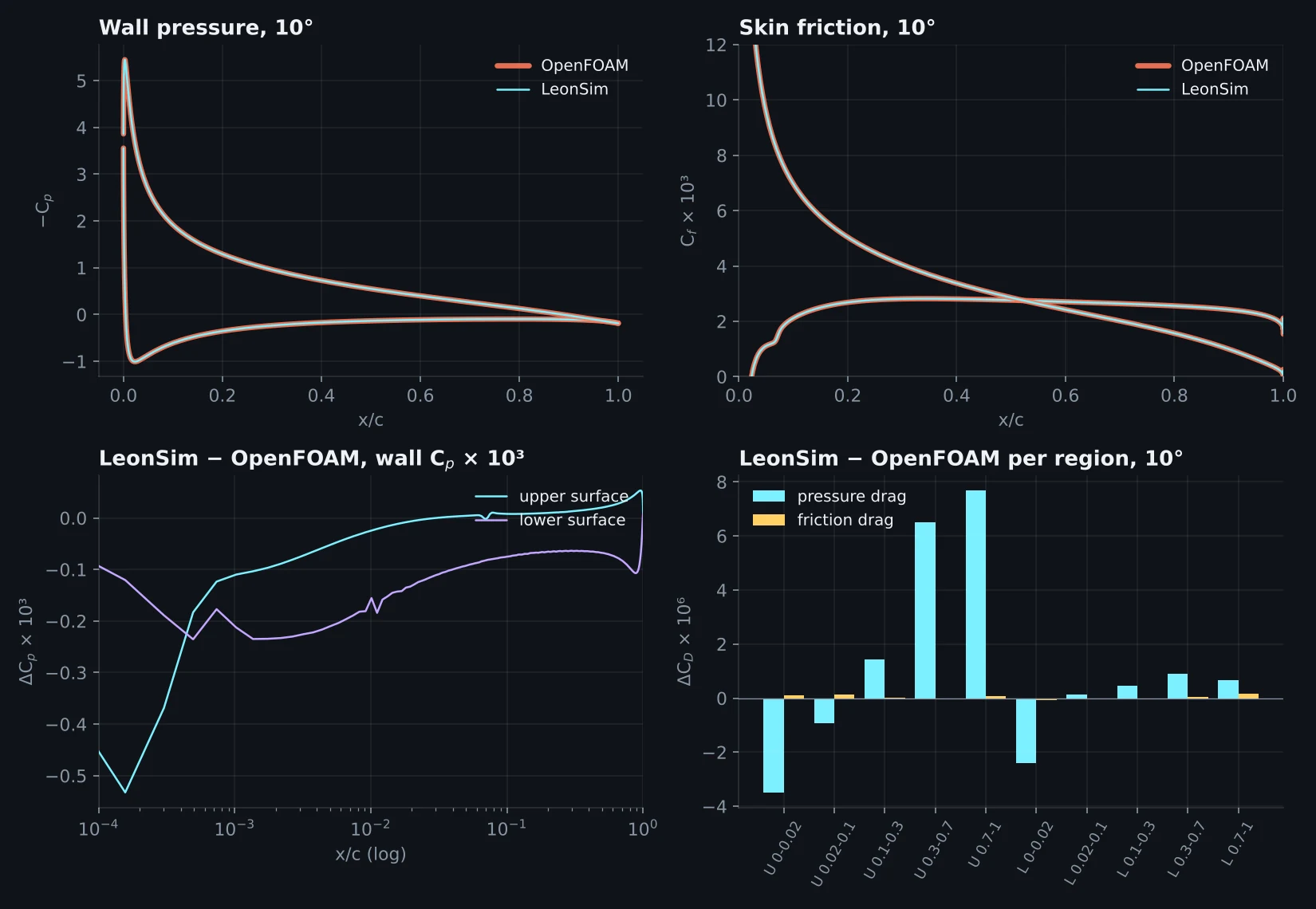
NACA 0012 against OpenFOAM, region by region
On the same mesh and with the same model, LeonSim and OpenFOAM agree on pressure and friction drag in every part of the wall. Against the wind tunnel, lift and zero-incidence drag hold. Drag at 10° is 15 % high, and we can say why.
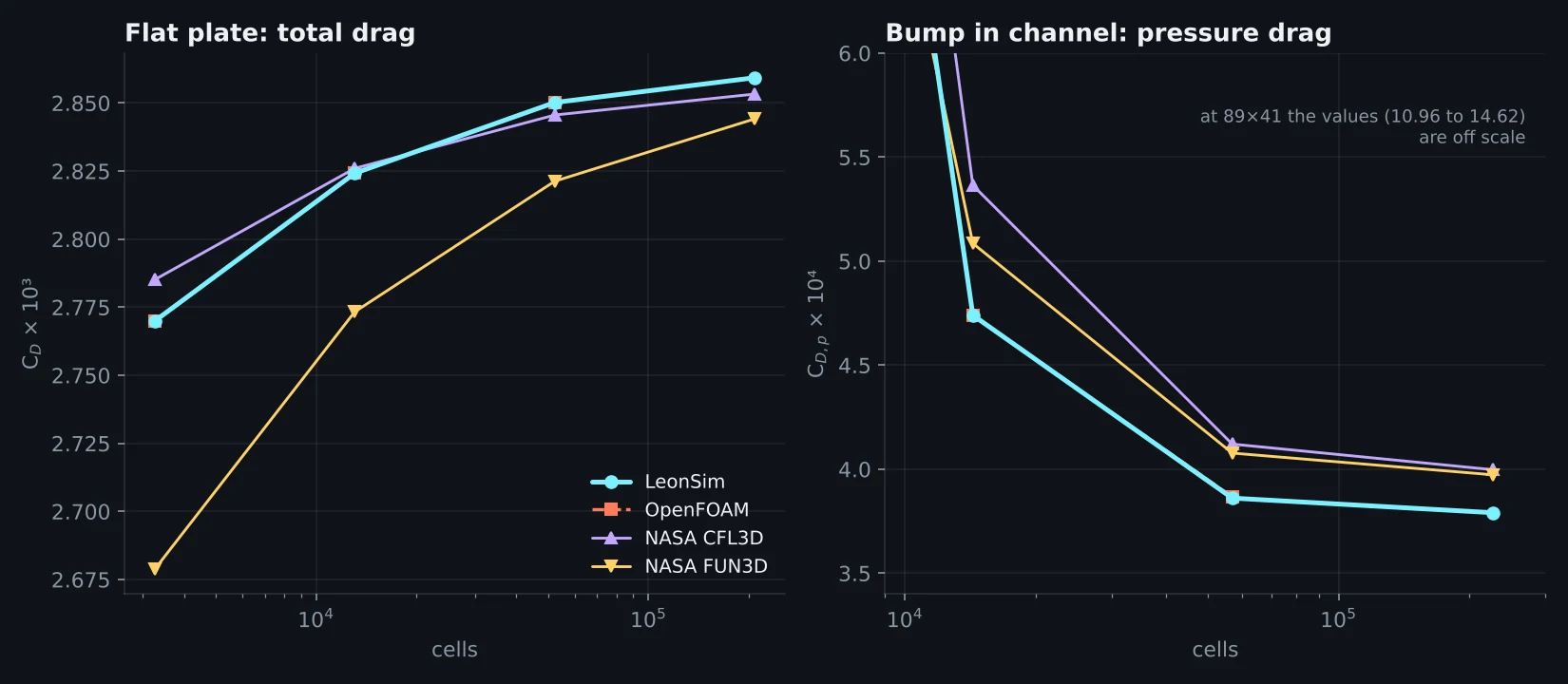
NASA’s flat plate and bump: LeonSim, OpenFOAM and NASA’s own codes
Two verification cases from NASA’s Turbulence Modeling Resource, run on NASA’s grids. LeonSim reproduces OpenFOAM to 0.001 to 0.04 %, and sits about 0.2 % (plate) and 0.6 % (bump) from NASA’s total drag. The bump’s pressure drag is 5 % low, and the reason is compressibility.
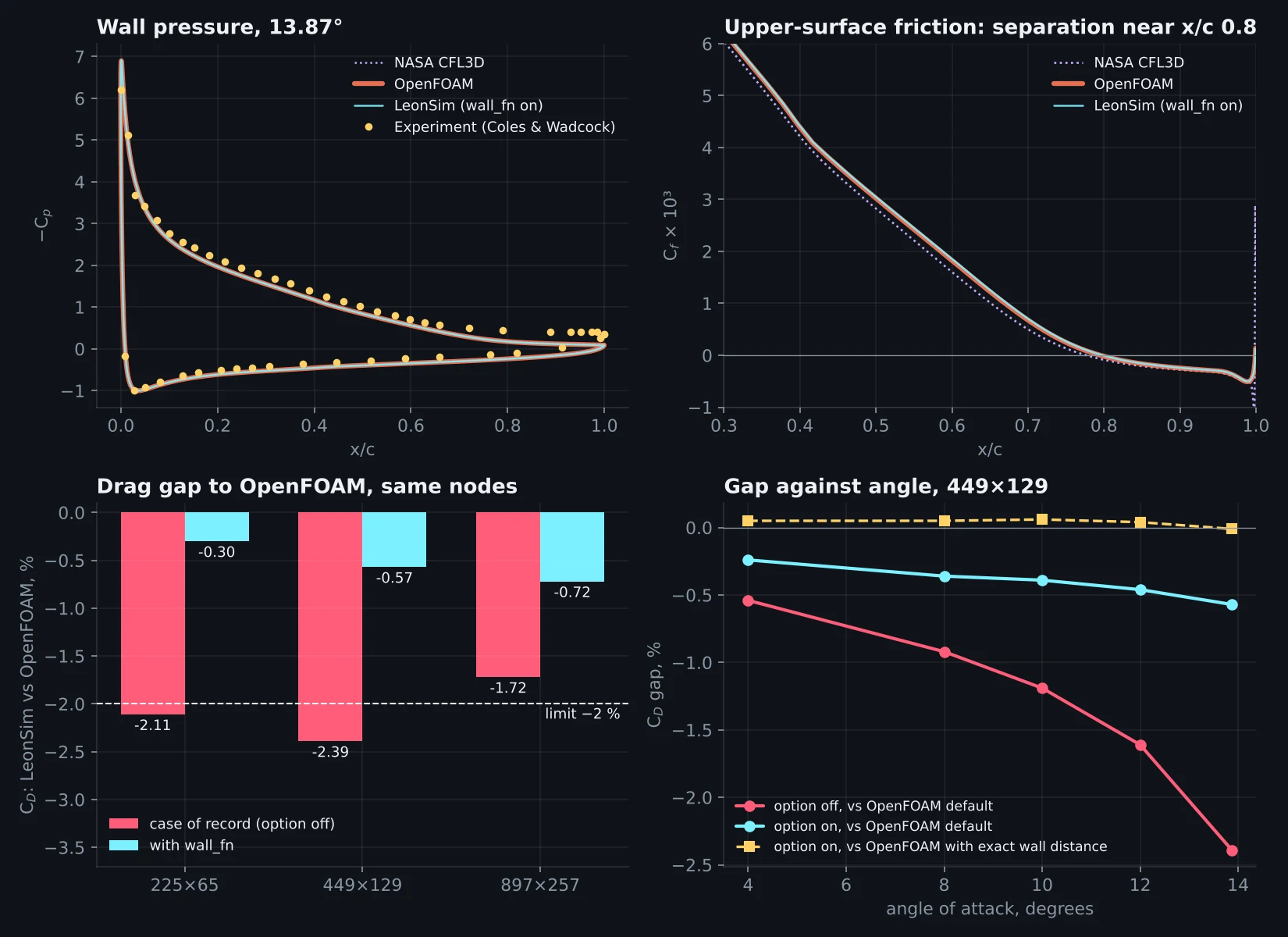
NACA 4412: a separated flow that missed its limit, and the wall-cell term behind it
Our second 2D gate case failed its own 2 % drag limit on two of three grids. We found the cause in how the wall-adjacent cell is treated, fixed it behind an option, and kept the failure on the record.
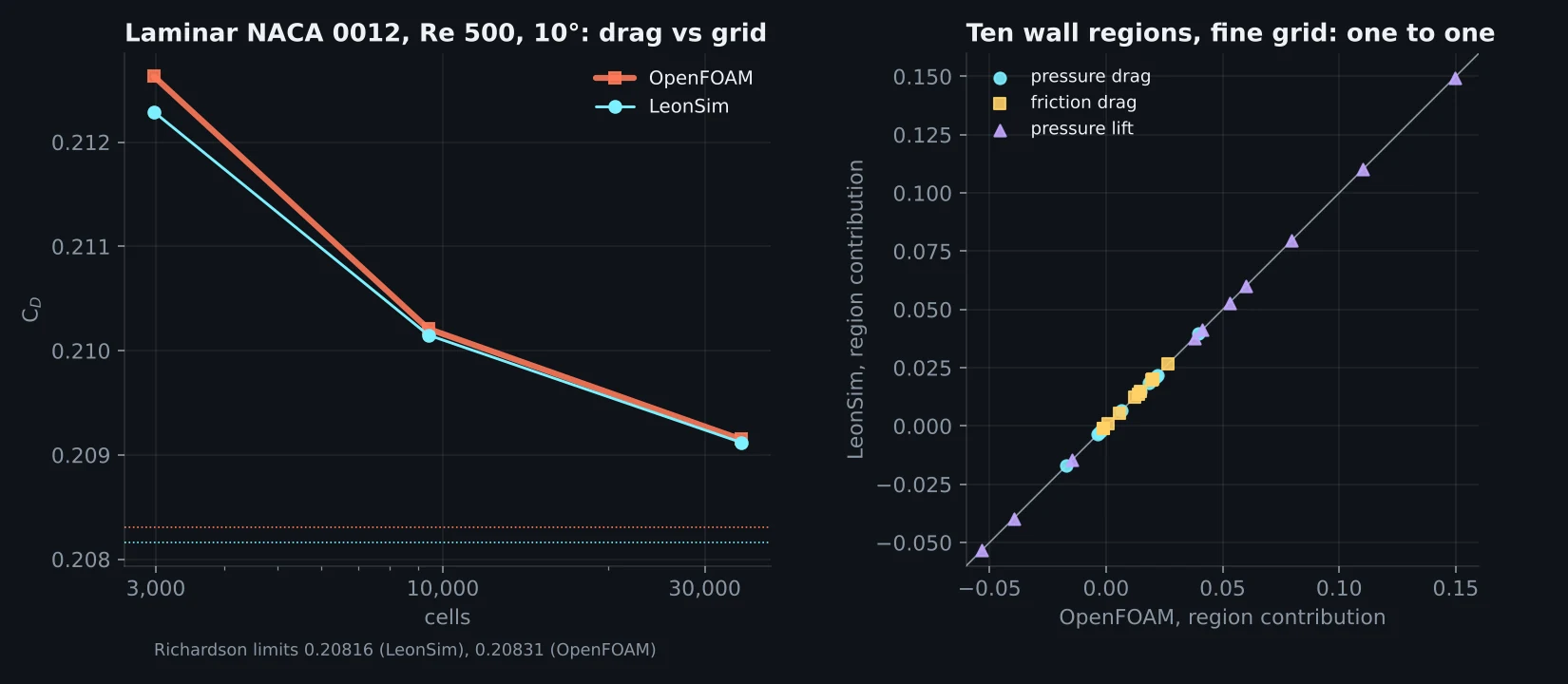
A laminar airfoil with no turbulence model to hide behind
At Reynolds number 500 there is no turbulence model to blame. LeonSim first answered 0.33 where OpenFOAM said 0.175, because the call went to the wrong solver. Fixed, the two agree to a few hundredths of a per cent in drag, on three grids and in every wall region.
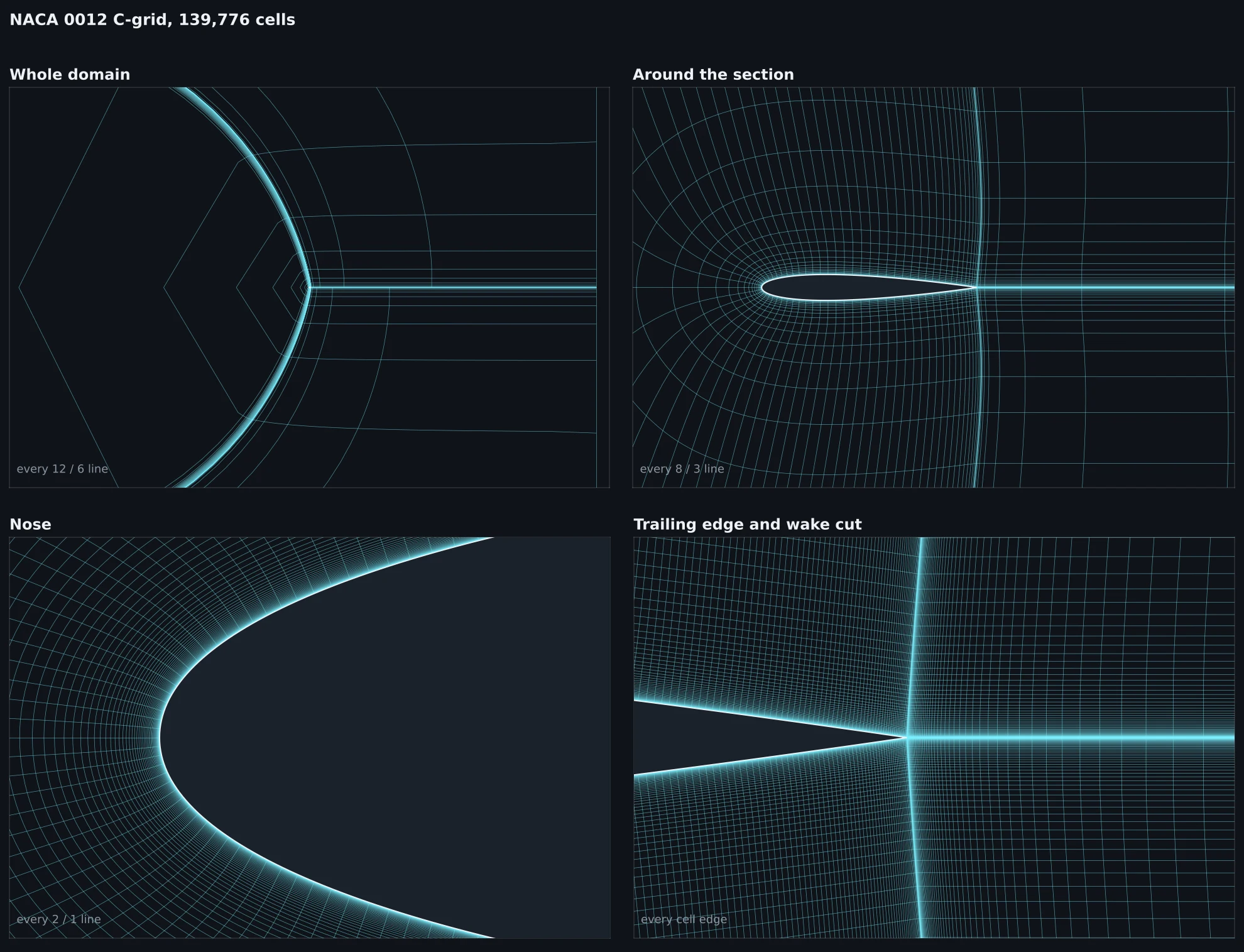
The meshes: compared in 2D, still being built in 3D
The C-grids behind every 2D code comparison row, drawn from the files both codes ran on, and the first 3D Ahmed meshes: the snappyHexMesh reference and our own LeonMesh, with its checkMesh failures listed.
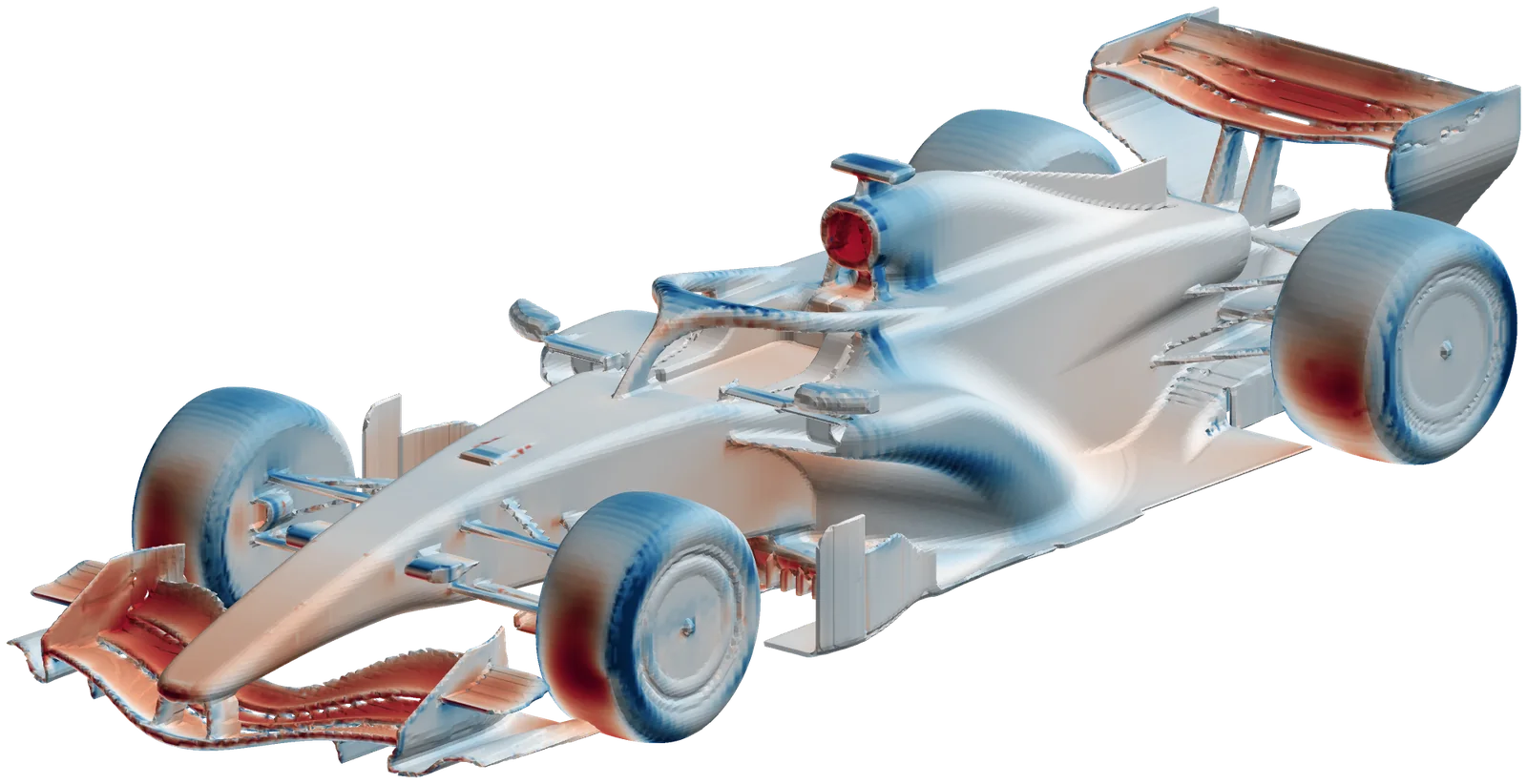
From 321 s to 37 s: a whole F1 CFD job on the GPU
The solver was already on the GPU. Most of the job's time was not. We profiled an F1 run on six NVIDIA GPUs, moved post-processing, geometry and rendering onto the device, and got 8.7× on an H100.
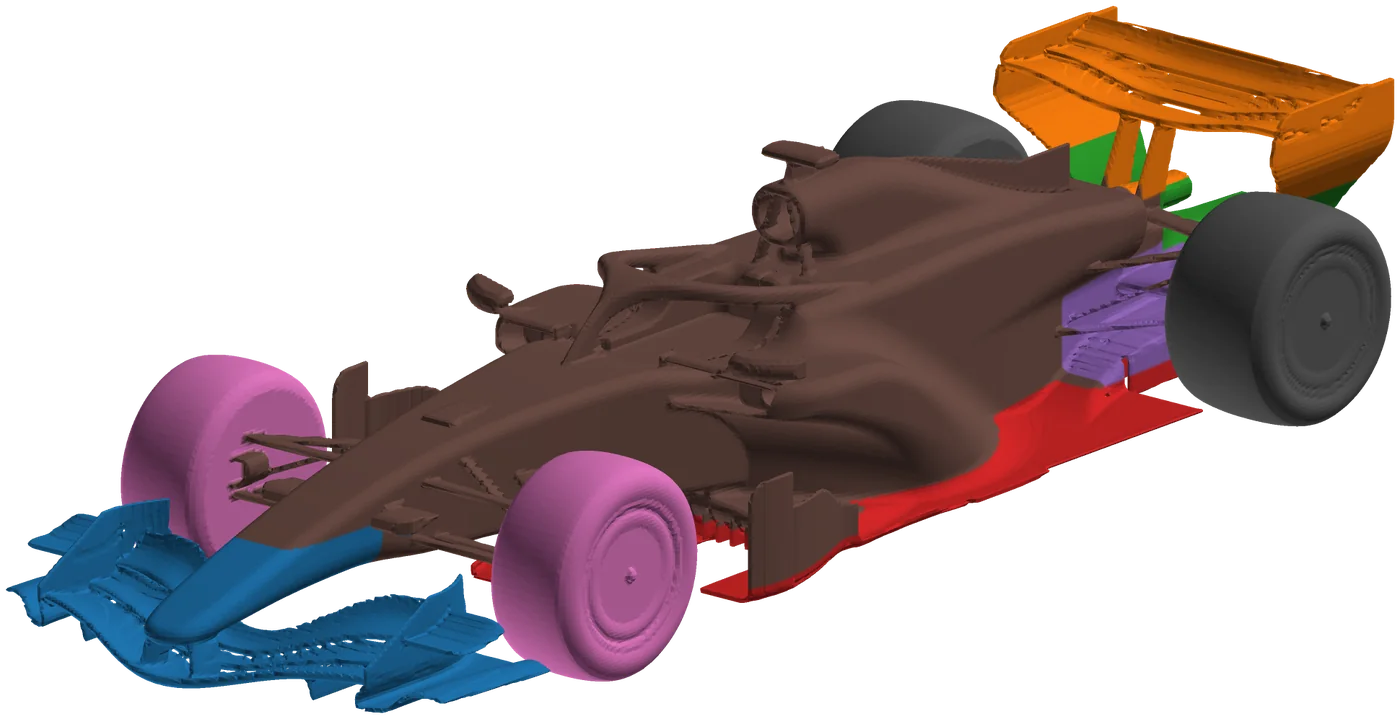
Tracing NumPy into WGSL: CAD geometry on the GPU
LeonSim’s car geometry is plain NumPy. Instead of porting it to a shader language, we run it once on tracer objects that record every operation and emit a WGSL kernel. Grid set-up went from 53 s to 2 s.
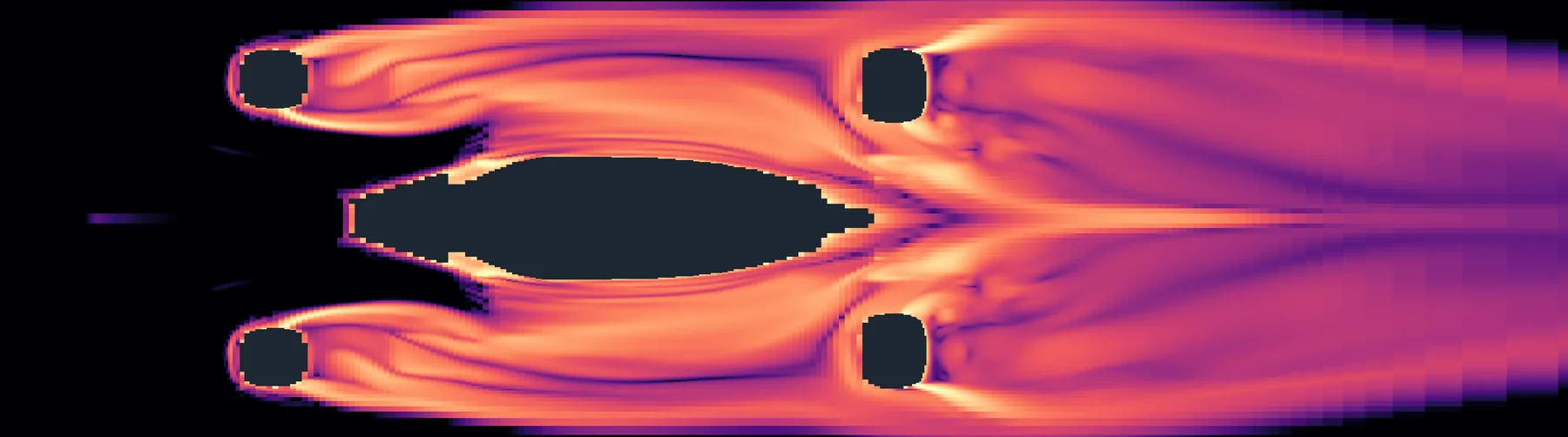
A race only the Radeon could see
Identical CFD runs on an AMD integrated GPU gave slightly different forces. The cause was a Gauss-Seidel loop inside one workgroup, and a barrier that did not mean what we thought on this hardware.

How certain is one CFD run?
We reran the 2026 concept car for 2000 iterations instead of 1000. Drag held still; downforce kept falling. What that means for the numbers we publish, and how to read a single steady RANS run of an F1 car.