Validation
Where LeonSim’s validation stands on 23 October
Four 2D cases have now been run three ways: against published data, against OpenFOAM on the same case, and in LeonSim. This is the status of each in one table, what each does not show, and what is not validated yet.
Status. Each row below carries its own label: code comparison passed, solution verification passed or no status yet. Nothing 3D has a status beyond preview, unvalidated.
Earlier posts on this blog reported accuracy numbers from our first solver, a Cartesian cut-cell code. Since then we adopted stricter rules, rebuilt the 2D path on a body-fitted, wall-resolved grid, and re-ran the cases that matter against OpenFOAM and against published data. This post is the index: one table, then the places where the table stops. The next four posts are the cases themselves.
Five labels
Every row and every result in the product carries one of five labels, and each label but the last names the row of docs/validation/validation-root-cause.md that earns it:
- Code comparison passed: agreement with another implementation under stated conditions.
- Code verification passed: analytic or manufactured-solution tests passed for stated capabilities.
- Solution verification passed: iterative, grid and time-step errors assessed for a stated case.
- Validated for a stated use: compared with experiment, including its uncertainty.
- Preview, unvalidated: none of the above. The numbers show the workflow and the flow, not an accuracy figure. Every 3D result is a preview today.
The rules a case has to meet
- Three ways. Published experiment or reference, OpenFOAM on the same case with the same turbulence model, schemes and wall treatment, and LeonSim. If one of the three does not exist, the row says so.
- Parts, not totals. Pressure and friction have to agree region by region along the wall. Two errors that cancel in total drag are not agreement.
- A stated grid-convergence order, or the statement that none can be given.
- A converged reference. If OpenFOAM or the published value is still drifting, the comparison is marked “reference not converged”.
- Options stay off by default until they pass every case on the scoreboard.
The scoreboard
| Case | Published reference | LeonSim against OpenFOAM, same set-up | Status |
|---|---|---|---|
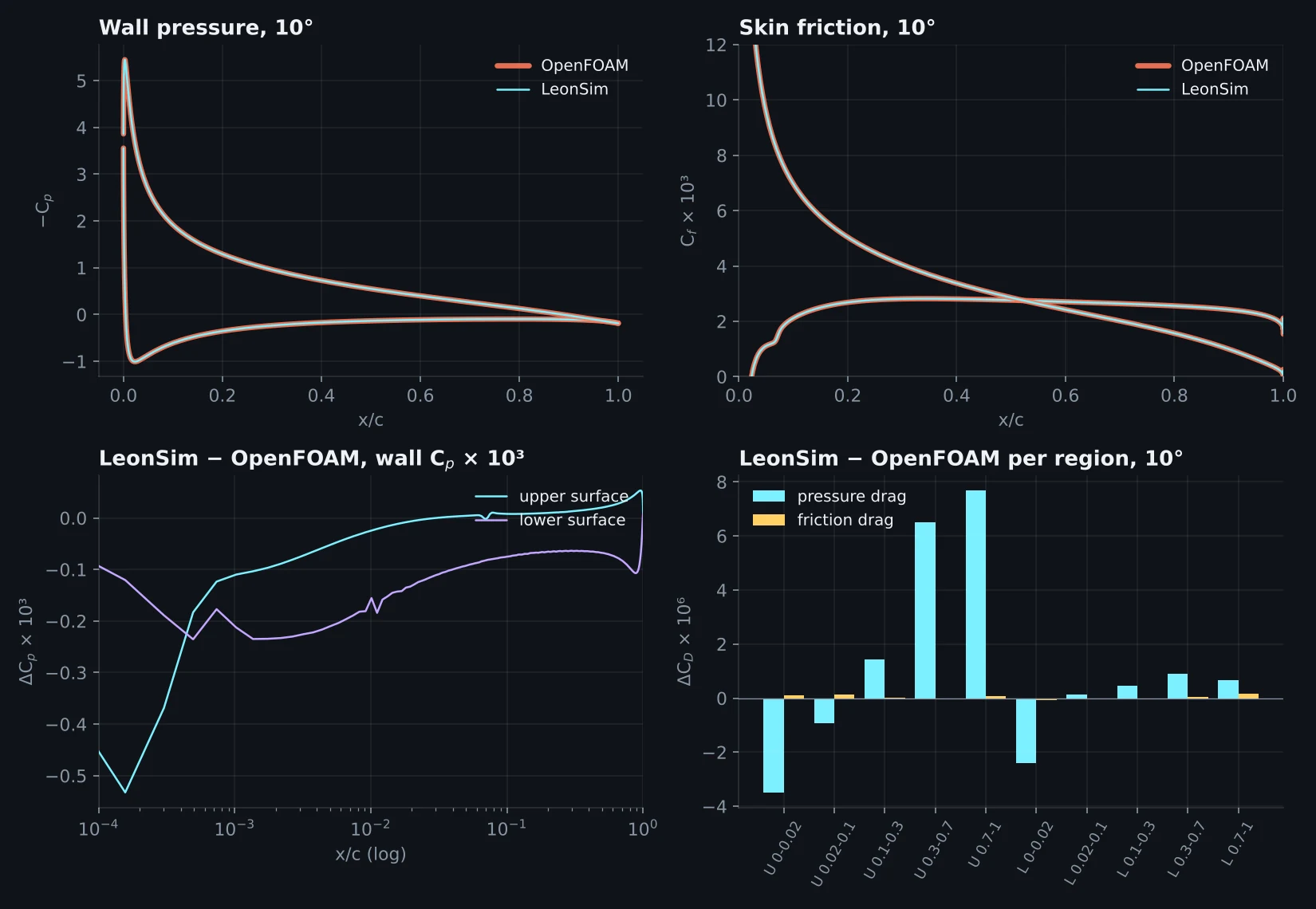
| NACA 0012, 0° and 10°, Re 6 M | Ladson, NASA TM-4074, tripped: CD 0.00807 at 0°; CL 1.063, CD 0.01169 at 10° | Pressure drag in every wall region within 6.5·10⁻⁷ (0°) and 7.7·10⁻⁶ (10°); friction within 1.6·10⁻⁷ | Code comparison passed against OpenFOAM; solution verification passed (grid ladder, stated orders). Not validated against experiment: CD at 0° −0.5 %, CL at 10° +0.1 %, CD at 10° +15 % and open. |
| NASA TMR flat plate and bump | NASA’s CFL3D and FUN3D results (code results, no experiment) | Plate within 0.001 %, bump total drag within 0.03 % (its pressure part within 0.14 %), on every grid where OpenFOAM is converged | Code comparison passed against OpenFOAM and NASA’s codes, not claimed as validation of a flow class. Bump pressure drag differs from NASA’s by an explained compressibility effect. |
| NACA 4412, trailing-edge separation, 13.87° | Coles & Wadcock wall pressure (qualitative, as NASA says); CFL3D and FUN3D | Drag −2.11 / −2.39 / −1.72 % on three grids against a 2 % limit; −0.30 / −0.57 / −0.72 % with a wall-cell fix that is off by default | No status yet. The case of record misses its limit on two of three grids. The cause is found and the fix is optional. |
| Laminar NACA 0012, Re 500 | None found for steady forces | Drag within 0.01 to 0.30 % on three grids; per region to 10⁻⁵ in pressure drag | No status yet. Two-way only (OpenFOAM and LeonSim), not yet a row of the validation log. GPU matches CPU to round-off at 10°. |
What agreement with OpenFOAM does and does not mean
Where LeonSim and OpenFOAM run the same model on the same mesh, agreement shows that LeonSim solves the same equations the same way. It does not show that the model matches nature. That is why every row also carries the published reference, and why two rows are honest about a gap to it: drag at 10° on the NACA 0012 is 15 % above the tunnel, and the NACA 4412 case of record misses its own drag limit. Both are explained in their posts.
Not validated
- Anything 3D, including the Ahmed body. The 3D paths, cut-cell and body-fitted, are a preview, unvalidated. No Ahmed drag figure, here or on the landing page, is a validation result under these rules: no Ahmed run so far, LeonSim’s or OpenFOAM’s, has reached a steady solution (residuals stall and the lift swings 5 to 21 % on the OpenFOAM grids), so every Ahmed coefficient is an iteration mean, labelled “steady solution not established”, and is not compared with the experiment or with another code as if it were a physical value. A time-accurate OpenFOAM run is the next step.
- The first, cut-cell solver that the tutorial posts of 15 October describe. Those posts now carry a status note. It is no longer the production path, and its drag at incidence was not validated.
- The meshfree particle solver (off by default) and the GPU mesher (what the meshes look like) are experiments. Neither contributes to any number above.
- Drag at incidence against experiment. Lift is fine. Drag at 10° carries both the far-field size and the turbulence model, and the far-field effect has not been removed on the finest grid.
Where to look
Every number on these pages comes from a recorded run in the repository: the per-case reports under docs/ and the shared log docs/validation/validation-root-cause.md, which also holds the failed attempts and the corrections. The figures in this series are produced by website/renders/validation_plots.py from those run files.